Astronomy Picture of the Day
Discover the cosmos! Each day a different image or photograph of our fascinating universe is featured, along with a brief explanation written by a professional astronomer.
2026 July 14
Discover the cosmos! Each day a different image or photograph of our fascinating universe is featured, along with a brief explanation written by a professional astronomer.
2026 July 14
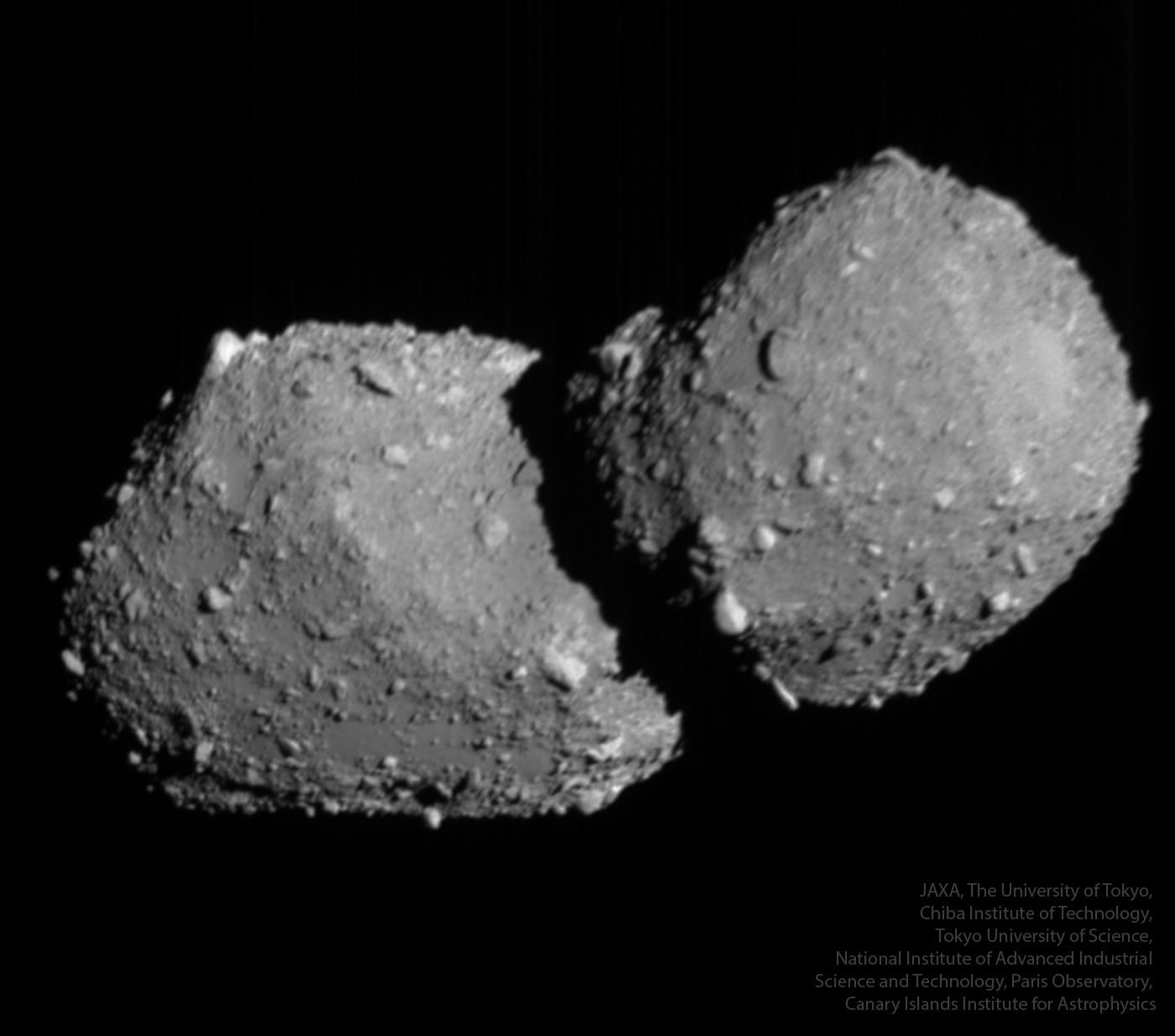
Explanation: Why is this asteroid a double? Earlier this month the Japanese robotic spacecraft Hayabusa2 shot past asteroid 98943 Torifune and captured pictures. Although previous observations from distant Earth indicated that Torifune was oblong, Hayabusa2 found that Torifune actually has two joined lobes. With a length of about four soccer fields, this space rock frequently comes near the Earth as it orbits the Sun, although it is not a threat. Besides the two lobes, Torifune shows many large boulders, but, surprisingly, no obvious craters, likely because its surface is a pile of rubble. Like asteroid Arrokoth, it appears that each lobe formed separately before colliding and becoming stuck together. Hayabusa2 famously encountered asteroid Ryugu in 2018, and now heads for an encounter in 2031 with 1998 KY26, a smaller asteroid that rotates unusually fast and might have reservoirs of ice.
Authors & editors:
Robert Nemiroff
(MTU) &
Jerry Bonnell (UMCP)
NASA Official: Amber Straughn
Specific rights apply.
NASA Web Privacy,
Accessibility,
Notices;
A service of:
ASD at
NASA /
GSFC,
NASA Science Activation
& Michigan Tech. U.
